The French Screen Goddess by Jonathan Driskell
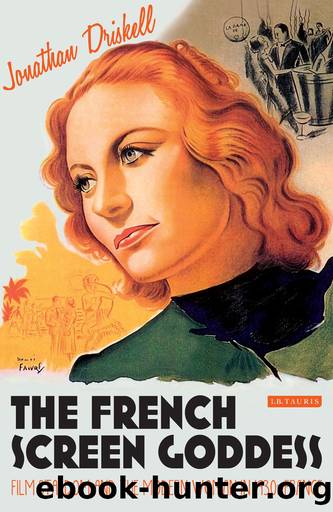
Author:Jonathan Driskell [Driskell, Jonathan]
Language: eng
Format: epub
Tags: Performing Arts, Film, History & Criticism, General
ISBN: 9780857726742
Google: C-iKDwAAQBAJ
Publisher: Bloomsbury Publishing
Published: 2015-03-26T04:33:17+00:00
The modern jeune fille
One of the main aspects of Darrieuxâs early persona was her embodiment of a naive and innocent jeune fille, a form of femininity that shared much of the humility and passivity of the midinette, but which tended to be associated with a higher social class, in part because the midinette was a worker. Discussing the jeune fille, Whitney Walton writes:
the French jeune fille [was] the sheltered, virginal, obedient young woman of the middle or upper class. For over a century, families of the comfortable classes in France expected marriage to be the destiny of their daughters, and they sought to protect the virginity and preserve the innocence of girls for this purpose. This was not always possible, especially after the economic, demographic and cultural disruption of World War I. Growing numbers of women seeking higher education and professional careers undermined the ideal of the bourgeois jeune fille. Nonetheless, this ideal resonated throughout France in the 1920s and 1930s.17
Central to Darrieuxâs creation of this femininity was her youthfulness, which stemmed in large part from her appearance; not only because she was young â owing to her direct entry into the cinema â but also because she had a particularly youthful physiognomy. Gisèle de Biezville wrote in Pour Vous: âThose of you who want to be like her, you have to pluck your eyebrows like her, which will accentuate your youthful appearance.â18 Her large childish eyes, which are one of the main sources of this juvenility, were often mentioned in her publicity of the period: âDanielle Darrieux âa graceful fresh-faced blonde ⦠her limpid eyes open on the world.ââ19 As with Annabella, such youthfulness was frequently used to denote vulnerability and passivity, qualities that were also stressed through the nature of her acting: she would often â though as we shall see, certainly not always â perform in a low-key and nuanced, self-effacing way. This is evident in Mayerling when Marie Vetsera (Darrieux) is at the opera, seated confined within her familyâs box. As Archduke Rudolph (Charles Boyer) gazes at her and the camera glides towards her face, she makes small movements, lowering her eyes and then after a couple more seconds, slowly turns her head. Within the context of the film, this acting is significant, ensuring that in relation to the larger, more powerful acting of the theatrically trained Boyer, she appears weak and submissive.
Darrieuxâs nuanced acting also brought âpurityâ to her jeune fille identity. In most of her films she remains virginal and in many â though again, as we shall see, certainly not all â she directs her attention towards idealised romantic love. As with Annabella, such purity is in part a product of her typical Aryan features (her white skin, light hair and pale eyes), characteristics that were emphasised in her films and publicity. In Mayerling, her whiteness and long neck associate her with the filmâs recurring motif of swans. When Rudolph first meets Marie at a fair in Vienna, he plays a game at
Download
This site does not store any files on its server. We only index and link to content provided by other sites. Please contact the content providers to delete copyright contents if any and email us, we'll remove relevant links or contents immediately.
| Anthropology | Archaeology |
| Philosophy | Politics & Government |
| Social Sciences | Sociology |
| Women's Studies |
Cecilia; Or, Memoirs of an Heiress — Volume 1 by Fanny Burney(32561)
The Great Music City by Andrea Baker(32021)
Cecilia; Or, Memoirs of an Heiress — Volume 2 by Fanny Burney(31958)
Cecilia; Or, Memoirs of an Heiress — Volume 3 by Fanny Burney(31944)
We're Going to Need More Wine by Gabrielle Union(19050)
All the Missing Girls by Megan Miranda(16038)
Pimp by Iceberg Slim(14515)
For the Love of Europe by Rick Steves(14149)
Bombshells: Glamour Girls of a Lifetime by Sullivan Steve(14078)
Talking to Strangers by Malcolm Gladwell(13375)
Norse Mythology by Gaiman Neil(13372)
Fifty Shades Freed by E L James(13245)
Mindhunter: Inside the FBI's Elite Serial Crime Unit by John E. Douglas & Mark Olshaker(9346)
Crazy Rich Asians by Kevin Kwan(9295)
The Lost Art of Listening by Michael P. Nichols(7507)
Enlightenment Now: The Case for Reason, Science, Humanism, and Progress by Steven Pinker(7315)
The Four Agreements by Don Miguel Ruiz(6767)
Bad Blood by John Carreyrou(6625)
Weapons of Math Destruction by Cathy O'Neil(6283)
